






Delivering Sustainable Buildings: Savings and Payback - Office Case Study for BREEAM UK New Construction 2014

While the multitude of benefits associated with investing in sustainable development practices are increasingly being recognised, for all new construction projects there is always a bottom line impact to consider.
It is for this reason that, in December 2017, a report exploring the cost implications of achieving BREEAM Very Good and Excellent assessment ratings has been undertaken and published.
The latest BREEAM Briefing Paper, titled 'Delivering Sustainable Buildings: Savings and Payback – Office Case Study for BREEAM UK New Construction 2014', uses a speculative office building project that was the basis of a similar report three years ago to review the costs of sustainability today.
The new work takes account of several factors including the increased energy performance demands of Building Regulations Part L2A and the updated assessment criteria of BREEAM UK New Construction 2014. It also examines the difference between BREEAM uplift costs for a building meeting London Plan energy requirements and the same building not so constrained.
The report is published by researchers at BREEAM and Currie & Brown, the leading international asset management and cost consultancy.
Gavin Dunn, Director at BRE, said:
“This Briefing Paper gives developers an updated picture of the cost implications of sustainable development. Both capital and lifecycle costs are considered. In particular, lifecycle costs are examined in respect of energy strategies, and water consumption, including different water supply tariffs.”
The report found that the cost uplift of achieving BREEAM UK New Construction 2014 Excellent ratings is typically less than one per cent of the total construction cost. Analysis of additional costs associated with BREEAM certification at a high standard in terms of energy efficiency and water saving technologies also showed that these costs are relatively modest and that forecast paybacks are quick – typically less than five years for energy and less than two years for water.
Adam Mactavish, operations director at Currie & Brown, points out: “Achieving a high rating under BREEAM 2014 can incur additional costs, but these are less than 1% of the total construction cost. Moreover, long-term savings on energy and water are substantial.”
The challenge for developers and clients is to make sure they consider these issues at an early stage in the design process to secure the benefits and take advantage of a building’s potential to deliver high performance standards by operating them efficiently.
To download a copy of this report see here.
This article was originally published here by BRE Buzz on 17th Dec 2017. It was written by Simon Guy.
--BRE Buzz
[edit] Find out more
[edit] Related articles on Designing Buildings Wiki
Featured articles and news
UK Net Zero Carbon Buildings Standard V1 published

Free-to-access technical standard to enable robust proof of a decarbonising built environment.
Prostate Cancer Awareness Month

Why talking about prostate cancer matters in construction.
The Architectural Technology podcast: Where it's AT

Catch up for free, subscribe and share with your network.
The Association of Consultant Architects recap

A reintroduction and recap of ACA President; Patrick Inglis' Autumn update.
The Home Energy Model and its wrappers

From SAP to HEM, EPC for MEES and FHS assessment wrappers.
Future Homes Standard Essentials launched

Future Homes Hub launches new campaign to help sector prepare for the implementation of new building standards.
Building Safety recap February, 2026
Our regular run-down of key building safety related events of the month.
Planning reform: draft NPPF and industry responses.
Last chance to comment on proposed changes to the NPPF.

A Regency palace of colour and sensation. Book review.
Delayed, derailed and devalued
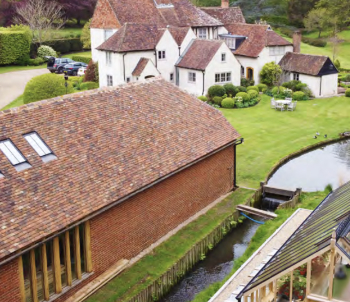
How the UK’s planning crisis is undermining British manufacturing.
How much does it cost to build a house?

A brief run down of key considerations from a London based practice.
The need for a National construction careers campaign

Highlighted by CIOB to cut unemployment, reduce skills gap and deliver on housing and infrastructure ambitions.
AI-Driven automation; reducing time, enhancing compliance
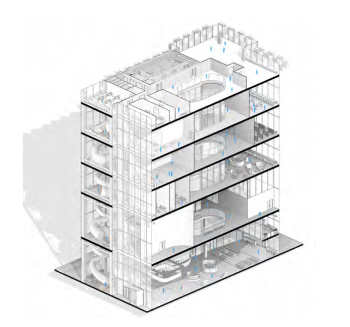
Sustainability; not just compliance but rethinking design, material selection, and the supply chains to support them.
Climate Resilience and Adaptation In the Built Environment
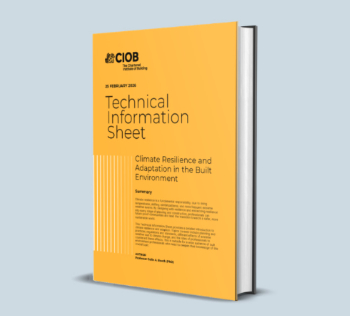
New CIOB Technical Information Sheet by Colin Booth, Professor of Smart and Sustainable Infrastructure.
Turning Enquiries into Profitable Construction Projects

Founder of Develop Coaching and author of Building Your Future; Greg Wilkes shares his insights.